Preparing skin before applying
Perfume interacts with whatever is already on your skin. Applying to clean skin is described as helping the true scent come through, because spraying onto dirty or sweaty skin can prevent the fragrance from developing as intended.
Moisturized skin is commonly described as holding fragrance better than dry skin. Applying an unscented lotion or a matching body cream before your perfume is described as creating a base that slows evaporation, so the scent lingers longer. No quantitative data is available on how much longer the fragrance lasts, so treat this as a general principle rather than a measured number.
- Start with clean skin; avoid spraying over leftover product or sweat.
- Apply unscented lotion or a matching body cream first to create a base.
- A matching or unscented body cream can slow evaporation so the scent lingers longer, according to commonly repeated guidance.
Sources: Scento, Near Store, Homecourt
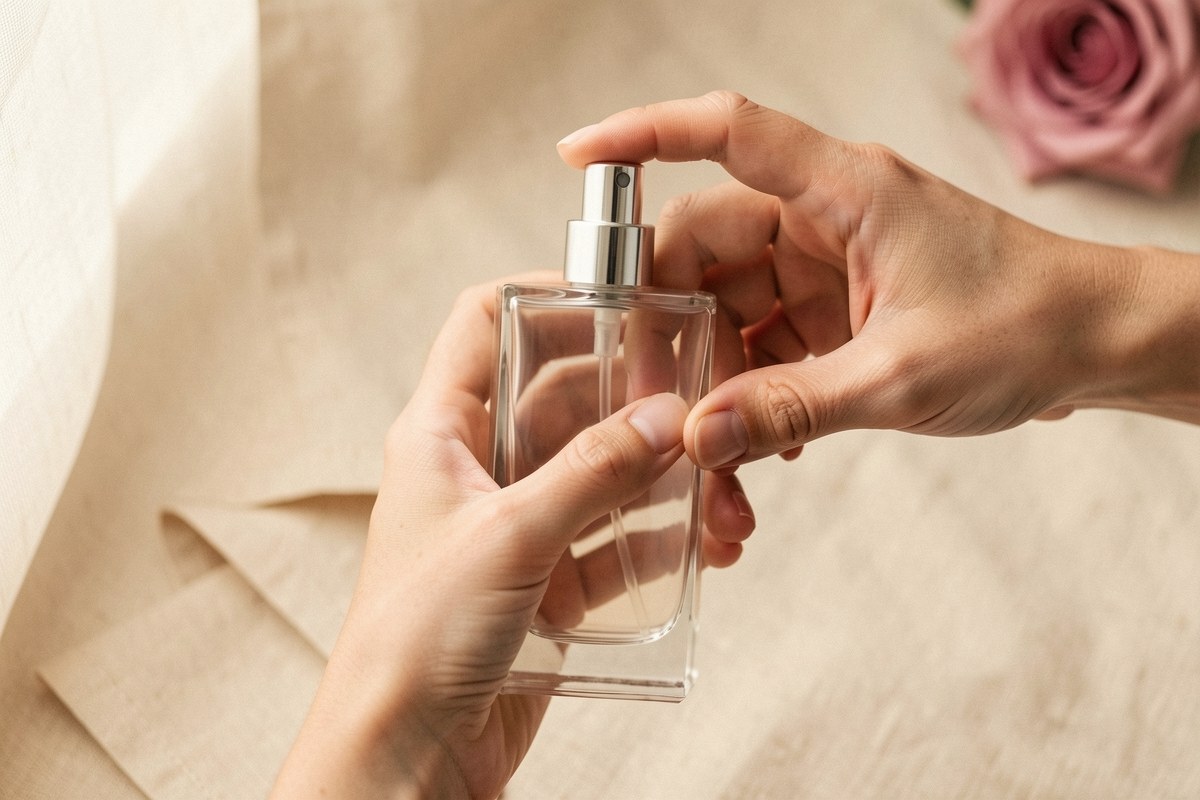
Where pulse points are and what they do
Pulse points are areas where blood vessels sit close to the skin's surface, producing localized warmth. That warmth is commonly described as helping fragrance molecules evaporate and spread more effectively than on cooler parts of the body, which can increase projection. It is also described as helping a scent move through its top, middle and base notes so it develops more fully over time.
Commonly cited pulse points include the wrists, the sides of the neck or throat, behind the ears, the inner elbows and behind the knees. Each placement changes how the scent is experienced.
- Wrists: described as providing steady diffusion throughout the day.
- Sides of the neck and collarbone: described as boosting projection so the scent is noticeable without being overpowering.
- Behind the ears: described as releasing scent subtly and gradually for a soft, intimate trail.
- Inner elbows: described as effective for longevity because the skin there is thinner, allowing more even diffusion.
- Behind the knees: described as a warm-weather placement because rising body heat carries the scent upward and it sits farther from the nose.
Sources: Scento, Near Store, Homecourt
A simple application routine
Spraying directly onto pulse points is described as more effective than spraying into the air and walking through the mist. One publisher recommends holding the bottle about 4 to 6 inches from the skin for an even mist rather than a concentrated spot; this distance is commonly cited but comes from a single source.
- Start with clean, moisturized skin.
- Choose two or three pulse points — for example, one wrist, the sides of the neck, or behind the ears. Concentrating on two or three areas is recommended for a balanced, long-lasting scent, as over-applying to every pulse point can overwhelm the fragrance.
- Hold the bottle 4 to 6 inches from the skin and spray once per area.
- Do not rub the wrists together. Rubbing is widely described as disrupting or breaking down the top notes and affecting how the scent develops; gently tapping or dabbing instead is the technique described by one publisher.
- Let the fragrance dry down. Perfume is described as tending to intensify as it warms on the skin, so start with a small amount and add more only if needed.
Sources: Scento, Near Store, Homecourt
How many sprays for different settings
A commonly cited total is 2 to 4 sprays of perfume, adjusted depending on the fragrance's concentration. This is editorial guidance from a single publisher rather than a standard. Lighter concentrations such as cologne typically need more sprays than a parfum or extrait, but exact counts vary by product.
For everyday wear, 2 to 3 sprays across two or three pulse points is a reasonable starting point. For evening or stronger concentrations, fewer sprays are often enough. A useful check before reapplying is to ask another person whether they can still detect the fragrance; scent fatigue, where the brain becomes used to a smell, is described as a reason a wearer may think their perfume has faded when it has not.
- Desk or office: 1 to 2 sprays, applied to wrists or behind the ears rather than the neck.
- Everyday outings: 2 to 3 sprays across two or three pulse points.
- Evening or strong concentrations: 1 to 2 sprays; intensify only if needed after the scent has warmed.
- Hot weather or enclosed spaces: fewer sprays and lower pulse points, such as behind the knees.
Sources: Scento, Near Store
Applying to clothing versus skin
Fragrance behaves differently on fabric than on skin. On skin, the scent develops with body heat and mixes with your skin's own chemistry. On clothing, it tends to last longer but changes less over time because there is no warmth or skin chemistry to drive the evolution of notes.
Applying fragrance to the ends of hair or to clothing is described as an additional diffusion option, with a caution that oils can stain fabrics and make hair greasy if overdone. This caution comes from a single publisher; if you are trying a new fragrance on a favorite garment, test on an inconspicuous area first.
If you want both longevity and development, a common approach is to spray once on skin at a pulse point and once lightly on a scarf or the inside of a jacket collar rather than directly on delicate fabric.
- Skin: develops with body heat, mixes with your chemistry, and changes over the wear.
- Clothing: tends to hold the scent longer but with less evolution; some oils can stain.
- Hair: can carry scent well, but oil-based products may make hair greasy if overdone.
- When in doubt, spray a tissue or fabric swatch first to check for staining.
Sources: Homecourt
Common over-application mistakes
Over-applying is the most common way to overwhelm a room. Spraying every pulse point is described as potentially overwhelming the fragrance, so focusing on two or three areas is recommended for a balanced, long-lasting scent.
Rubbing the wrists together after spraying is widely described as disrupting or breaking down the fragrance's top notes and affecting how the scent develops on skin. The mechanism is commonly stated rather than proven, but the advice to avoid rubbing is consistent across sources.
Reapplying because you can no longer smell your own perfume is another common mistake. Scent fatigue is described as a reason a wearer may think their perfume has faded when it has not; checking with another person before reapplying can help avoid over-application.
- Do not spray every pulse point; two or three is enough.
- Do not rub wrists together; tap or dab instead.
- Do not reapply without checking with someone else first.
- Do not spray into the air and walk through the mist; direct application to pulse points is described as more effective.
Sources: Scento, Near Store, Homecourt
Adjusting application for hot weather and enclosed spaces
Warmth increases evaporation, so a fragrance that feels subtle in cool air can project much more in heat. In hot weather, a dab behind the knees is described as less likely to overwhelm than neck application because it sits farther from the nose and rising body heat carries the scent upward.
Enclosed spaces such as offices, cars or elevators trap scent. The same application that feels appropriate outdoors can become overpowering indoors. Reducing the number of sprays and choosing lower pulse points helps keep the fragrance within your personal space.
Perfume oils are described by one publisher as having a softer sillage than alcohol-based sprays because there is no alcohol, so the scent stays closer rather than projecting across a room. This is a single-source assertion and not independently verified. If you spend most of your day in shared indoor spaces, a lighter application or an oil format may be easier to wear comfortably.
- Hot weather: drop to 1 to 2 sprays and use lower pulse points like behind the knees.
- Enclosed spaces: apply less than you would outdoors; scent accumulates in still air.
- Shared offices: consider applying after you arrive rather than before you leave home.
- Oil formats: described by one source as staying closer to the body, which can suit close quarters.
Sources: Homecourt
Frequently asked questions
Should I rub my wrists together after spraying?
No. Rubbing the wrists together is widely described as disrupting or breaking down the fragrance's top notes and affecting how the scent develops on skin. The precise mechanism is commonly stated rather than measured, but the advice is consistent. If you want to blend the scent, gently tap or dab rather than rub.
Sources: Scento, Near Store, HomecourtIs it better to spray on skin or on clothes?
They serve different purposes. On skin, fragrance develops with body heat and skin chemistry, so it changes over the wear. On clothing, it tends to last longer but evolves less. One publisher cautions that oils can stain fabrics and make hair greasy if overdone. A practical middle ground is to spray once on skin and, if you want more staying power, lightly on a scarf or inner collar rather than delicate fabric.
Sources: HomecourtHow many sprays is normal for everyday wear?
A commonly cited total is 2 to 4 sprays, adjusted for the fragrance's concentration. This is editorial guidance from a single publisher rather than a standard. For everyday wear, 2 to 3 sprays across two or three pulse points is a reasonable starting point. Lighter concentrations may need more; stronger ones may need fewer.
Sources: ScentoDoes applying after moisturizer change how long it lasts?
Yes, according to commonly repeated guidance. Fragrance is described as clinging better to moisturized skin, so applying an unscented lotion or a matching body cream before perfume creates a base that slows evaporation and lets the scent linger longer. No quantitative data on how much longer it lasts was provided, so treat this as a general principle rather than a measured number.
Sources: Scento, Near Store, Homecourt