Why concentration labels exist
A fragrance is a mixture of fragrance oil and a carrier, usually alcohol. Concentration is simply the ratio of oil to the finished liquid: a 20 percent concentration contains 20 milliliters of fragrance oil per 100 milliliters of product, and a 5 percent concentration contains 5 milliliters per 100 milliliters. That single number sets the starting height of a scent on skin and in the air.
The words on the front of the bottle, however, are not strict measurements. Concentration tier names such as parfum, eau de parfum, eau de toilette and eau de cologne are not legally standardized as concentration categories in most markets. They carry strong consumer expectations, but a name alone does not guarantee a percentage.
- Concentration means fragrance oil divided by total finished product, not oil divided by alcohol alone.
- Higher concentration generally means more oil per spray, but the same tier name can cover very different formulas across brands.
- Labels exist to set expectations about strength, longevity and typical use, not to certify a specific percentage.
Sources: Première Peau, Packamor
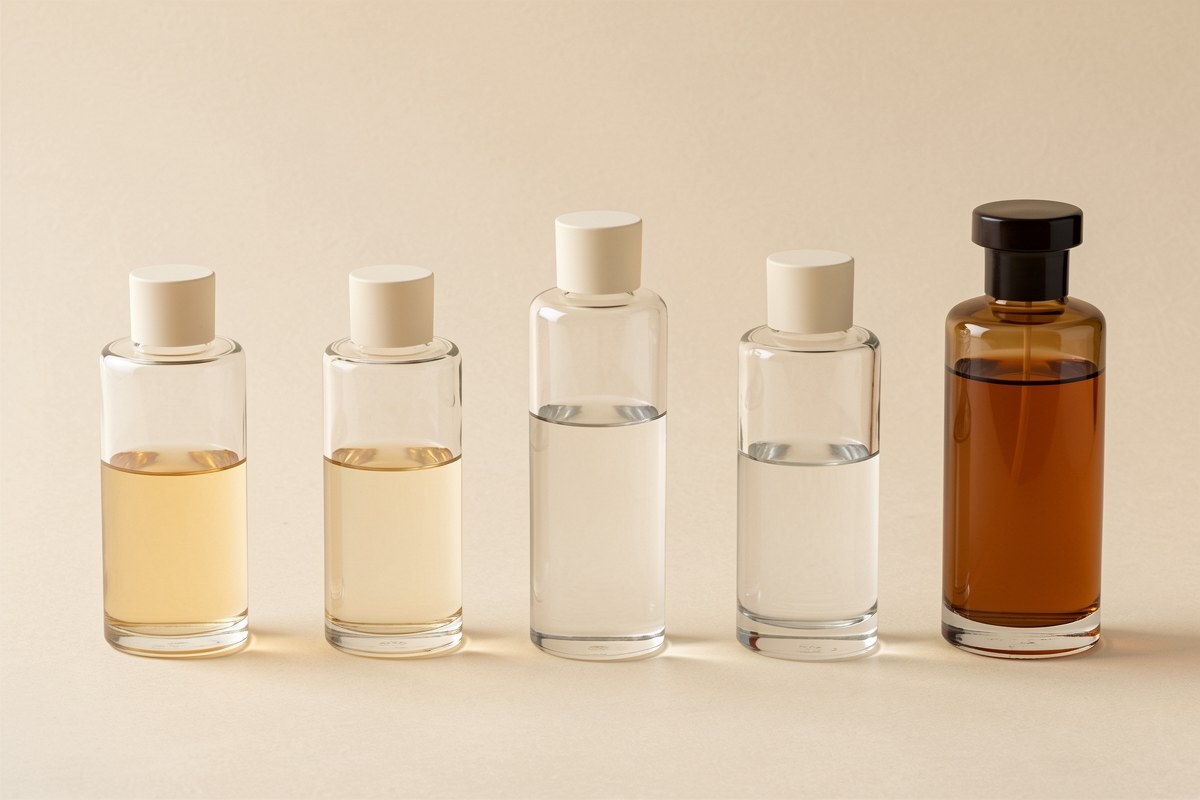
parfum (extrait)
Parfum, also written extrait de parfum or extrait, sits at the top of the conventional ladder. One supplier guide lists parfum at 20 to 40 percent fragrance oil, with some niche and luxury houses at 30 to 35 percent. An independent retailer guide gives a lower and wider range of 15 to 30 percent. The two ranges overlap between 20 and 30 percent, and the disagreement is itself useful: the term tells you approximately where a fragrance sits, not exactly how much oil it contains.
Historically, extrait de parfum was the reference form in which a composition was first built and sold, and lighter concentrations were derivatives of it. Extrait formulas also tend to carry a higher proportion of low-volatility materials, which is why a well-built extrait can read as denser and more textured rather than simply louder.
- Typical concentrate range: 15 to 30 percent in one industry guide, 20 to 40 percent in another.
- Usually positioned as the most concentrated and most expensive tier, though no law enforces a floor or ceiling.
- Often sold in smaller bottles, since a little goes further.
Sources: Première Peau, Packamor
Eau de parfum (EDP)
Eau de parfum is the concentration most people meet first. One guide lists it at 10 to 20 percent fragrance oil; a packaging supplier guide lists it at 15 to 20 percent and describes it as the current industry standard for premium fine fragrance. Because the two ranges overlap, a fragrance labeled eau de parfum at 15 percent could be chemically similar to an extrait at the same percentage from a different house.
Eau de parfum is also the newest of the conventional tiers. According to one retailer guide, labels reading parfum de toilette and eau de parfum began appearing in the 1970s and became standard through the 1980s. Today it is often described as the default launch strength for most new fragrances, a matter of retail habit as much as chemistry.
- Typical concentrate range: 10 to 20 percent in one guide, 15 to 20 percent in another.
- Usually the widest available range within a single fragrance line, including bottles, refills and travel sizes.
- Often the version most reviewers and retailers treat as the reference scent.
Sources: Première Peau, Packamor
Eau de toilette (EDT)
Eau de toilette is the classic daytime concentration in mainstream retail. One guide puts it at 5 to 15 percent fragrance oil; a supplier guide narrows that to 8 to 15 percent. The lower half of the range is where the two sources disagree most, and that gap is a good illustration of how loose these categories are.
Historically, eau de toilette began as a day-wear derivative. One retailer source states that in the first half of the twentieth century, houses offered a single composition at two strengths by pairing the extrait with a lighter, brighter daytime version. That habit never disappeared; it became a common way fragrance lines are sold.
- Typical concentrate range: 5 to 15 percent in one guide, 8 to 15 percent in another.
- Often brighter and more openly diffusive in the opening, with a lighter drydown than the extrait.
- Commonly sold in larger bottles at a lower price per milliliter than the extrait.
Sources: Première Peau, Packamor
eau de cologne and eau fraiche
Eau de cologne is described by one retailer guide as the oldest of the five tiers and the only one named after a place. That same source states that Giovanni Maria Farina launched his Eau Admirable in Cologne in 1709 as a citrus-and-herb construction in rectified grape alcohol. Low strength is the intention here rather than a compromise: a cologne is meant to be splashed, reapplied and worn lightly.
Both supplied industry guides agree on concentration ranges for these two lowest tiers. Eau de cologne is typically 2 to 5 percent fragrance oil. Eau fraiche, also called brume or body mist, is typically 1 to 3 percent and is sometimes carried in water with an emulsifier rather than alcohol. Eau fraiche has no historical claim; it is a commercial descriptor for a dilute product rather than a defined rung in a system.
- Eau de cologne: typically 2 to 5 percent oil, with a bright, fleeting character by design.
- Eau fraiche, brume and body mist: typically 1 to 3 percent oil, often used for body mists, hair mists and fabric sprays.
- The word cologne is also used casually in the United States as a synonym for men's fragrance, so a product sold as cologne may actually be an eau de toilette or eau de parfum.
Sources: Première Peau, Packamor
Comparison table: oil strength, longevity tendency and typical use
The table below compares the five common concentration terms side by side. The oil ranges are drawn from two independent industry guides and are presented as conventions, not thresholds. The longevity column reflects customer expectations described by one packaging supplier guide, not measured performance. Longevity varies with the formula, the wearer's skin and the climate.
Read the table as a set of tendencies, not guarantees. An eau de toilette built on low-volatility materials can outlast a citrus-heavy extrait, because the concentration sets the starting height while the materials set how quickly the scent fades.
- Only eau de cologne (2 to 5 percent) and eau fraiche (1 to 3 percent) agree exactly between the two industry guides.
- Parfum, eau de parfum and eau de toilette all show wider ranges that differ between publishers.
- Longevity is a tendency, not a promise; the same name can behave differently on different people.
| Concentration term | Typical oil range | Longevity tendency on skin | Common use |
|---|---|---|---|
| Parfum / extrait de parfum | 15–30% in one guide; 20–40% in another | 8–12 hours or longer | Evening wear, cold weather, special occasions |
| Eau de parfum (EDP) | 10–20% in one guide; 15–20% in another | 6–10 hours | Everyday wear, cooler months, signature scent |
| Eau de toilette (EDT) | 5–15% in one guide; 8–15% in another | 4–6 hours | Daytime, warm weather, office and casual use |
| Eau de cologne (EDC) | 2–5% | 2–3 hours | Splashing after a shower, hot weather, quick refresh |
| Eau fraiche / brume / body mist | 1–3% | 1–2 hours at most | Body mists, hair mists, fabric sprays, layering |
Sources: Première Peau, Packamor
Why the same name can differ between brands
The tiers overlap rather than stack neatly. Every tier's typical range overlaps the tier above it, so the same oil percentage can fairly carry two different label names. An eau de toilette from one house can hold more perfume concentrate than an eau de parfum from another.
There is also no single legal definition to fall back on. One of the industry guides describes parfum, eau de parfum, eau de toilette and cologne as industry terms that are not legally standardized in most markets. In the United States, the FDA accepts eau de parfum, eau de toilette, cologne or simply perfume as the statement of identity on a fragrance label without attaching a percentage to any of them. One retailer source cites 27 CFR 20.122 as requiring an article made with Specially Denatured Alcohol Formula 39-C to contain at least 2 fluid ounces of perfume material per gallon of finished product, about 1.6 percent by volume. That rule concerns tax eligibility for a specific alcohol formula, not fragrance quality.
- Tier names are conventions with strong consumer expectations, not regulated concentration categories.
- The same name can describe different percentages at different houses.
- The only concentration floor in the cited US rule applies to a specific denatured alcohol formula and is about tax eligibility, not fragrance quality.
Sources: Première Peau, Packamor
How standards treat the tiers
Safety and labeling rules do not usually separate the tiers by name. One retailer guide states that IFRA Standards, which set usage limits for fragrance materials, sort every alcoholic fine fragrance into a single product category, Category 4, covering eau de toilette, eau de parfum, parfum and cologne without distinction. Because the limits are expressed as upper concentrations of the material in the finished consumer product, a restricted material's percentage works out higher in a high-concentration version than in a low-concentration version of the same formula. A formula has to be rebalanced when it is concentrated.
On the labeling side, one retailer guide states that Commission Regulation (EU) 2023/1545 added 56 fragrance allergens to Annex III of the cosmetics regulation, taking the declarable total to 80, with a threshold above 0.001 percent in leave-on products. For products sold in the United States, one packaging supplier states that the FDA does not require a concentration tier on a cosmetic fragrance label, though it is expected industry practice and consumers look for it.
- IFRA treats eau de toilette, eau de parfum, parfum and cologne as the same product category for material limits.
- Allergen declaration thresholds apply to the finished product, not the concentrate.
- Concentration terms are not mandated on US cosmetic fragrance labels but are widely used as market convention.
Sources: Première Peau, Packamor
Reading a concentration on a real label
When you pick up a bottle, the concentration term is usually printed near the brand name or on the front panel, sometimes with an abbreviation such as EDP, EDT or EDC. Check the front and side of the physical bottle, and look on the box as well; the term may appear in smaller type near the volume or ingredients. Treat it as a starting point. The name tells you approximately where the fragrance sits in its own line, but it does not tell you the oil percentage, the materials used, or how long it will last on your skin.
A few practical points help. If the label says eau de toilette, expect a lighter, brighter experience than the extrait of the same fragrance, but compare the two on skin if you can. If the label says cologne, check whether the product is a low-concentration splash or a men's fragrance marketed under the word cologne; the two are different things. If the label says eau fraiche or body mist, expect a light, reapplyable product rather than a long-wearing fragrance. And if the label says extrait, remember that concentration is not the same as loudness: extraits often project more quietly than an eau de parfum while lasting longer.
- Look for the concentration term near the brand name, often abbreviated EDP, EDT or EDC.
- Check the front, side and box of the physical bottle, since placement varies by brand.
- Treat the term as a relative position within the brand's own line, not as a universal standard.
- Compare two concentrations of the same fragrance on your own skin rather than relying on the name alone.
Sources: Première Peau, Packamor
Frequently asked questions
Does eau de toilette always disappear faster than eau de parfum?
No. Concentration sets the starting height, but the materials in the formula set how quickly a scent fades. A citrus-heavy eau de toilette might be gone in a few hours, while an eau de toilette built on low-volatility materials can still be detectable at hour eight. An extrait built mainly on fast-evaporating citrus can be gone within about an hour. Longevity depends on the molecules in the bottle, your skin and the climate, not just the name on the label.
Sources: Première Peau, PackamorIs extrait de parfum meant for evening only?
Not necessarily. Extrait is the most concentrated tier in the conventional ladder, and it is often marketed for evening or cold-weather wear because it tends to be denser and longer-lasting. But there is no rule that restricts it to evenings. Many people wear extraits during the day in small doses, and a well-built extrait can read as denser rather than louder, which makes it wearable in more settings than the name suggests.
Sources: Première PeauWhy do some brands use different names for the same strength?
Because the tier names are conventions, not regulated categories. The ranges overlap, so the same oil percentage can fairly carry two different label names, and a brand may choose the name that fits its marketing, its packaging or the expectations of its customers.
Sources: Première Peau, PackamorCan a cologne last all day?
A true eau de cologne at 2 to 5 percent oil is typically expected to last around 2 to 3 hours on skin, so all-day wear is unlikely without reapplying. But the word cologne is also used casually in the United States as a synonym for men's fragrance, and many products sold as cologne are actually eau de toilette or eau de parfum. If the product is an eau de parfum in disguise, it can last considerably longer.
Sources: PackamorIs eau fraiche a concentration or a marketing term?
It functions as a commercial descriptor rather than a defined rung in a system. Both industry guides put eau fraiche at roughly 1 to 3 percent fragrance oil, which places it below eau de cologne, but the term has no historical claim or legal definition behind it. It is typically used for body mists, hair mists and fabric sprays, and the carrier is sometimes water with an emulsifier rather than alcohol.
Sources: Première Peau, PackamorDoes the concentration name tell me anything about quality?
Not directly. Concentration is a ratio of fragrance oil to finished product, and it says nothing about the quality of the materials, the skill of the composition or how well the fragrance will suit you. A high-concentration extrait can be built from inexpensive materials, and a well-made eau de toilette can be more interesting than a poorly made parfum. The name tells you approximately where the fragrance sits in its line, not how good it is.
Sources: Première Peau, Packamor