What to learn first as a beginner
Getting started with perfume goes faster when you treat the first weeks as vocabulary-building rather than shopping. You do not need to memorise a fragrance wheel before you smell anything. You need a small working model you can hang impressions on.
The most useful early idea is that a fragrance is described in stages. Top notes are the first impression, usually lasting roughly the first fifteen minutes. Heart or middle notes carry the main personality of the scent. Base or dry-down notes are the deepest, longest-lingering phase. Top notes are the most volatile and evaporate quickest, while base notes are the least volatile and can linger on skin for hours. That single model explains why a scent you disliked at first spray can become something you enjoy twenty minutes later — and why judging from the opening is a common beginner error.
The second idea is concentration wording. Packaging labels describe how much aromatic material a fragrance carries, and the usual beginner explanation is that eau de cologne sits around 2–4%, eau de toilette around 5–15%, eau de parfum around 15–25%, and parfum or extrait around 15–40%, with mists and eau fraîche at roughly 1–3%. Those bands overlap and vary by house, so treat them as a rough map of strength and price, not as precise cut-offs.
A third useful habit is to decide how you want to feel before you decide what to buy — fresh, romantic, warm, bold or clean — and then explore one or two fragrance families that match that mood in a small group of scents, rather than smelling everything at once. Once this vocabulary is in place, the note reference material on this site becomes far easier to use.
- Stages: top notes first (roughly the first 15 minutes), then heart notes, then base or dry-down notes
- Volatility: top notes fade fastest; base notes linger longest on skin
- Concentration labels overlap between houses, so use them as a rough strength guide
- Mood first, family second, individual fragrance third
- Small groups of scents beat large unstructured smelling sessions
Sources: Zermat USA
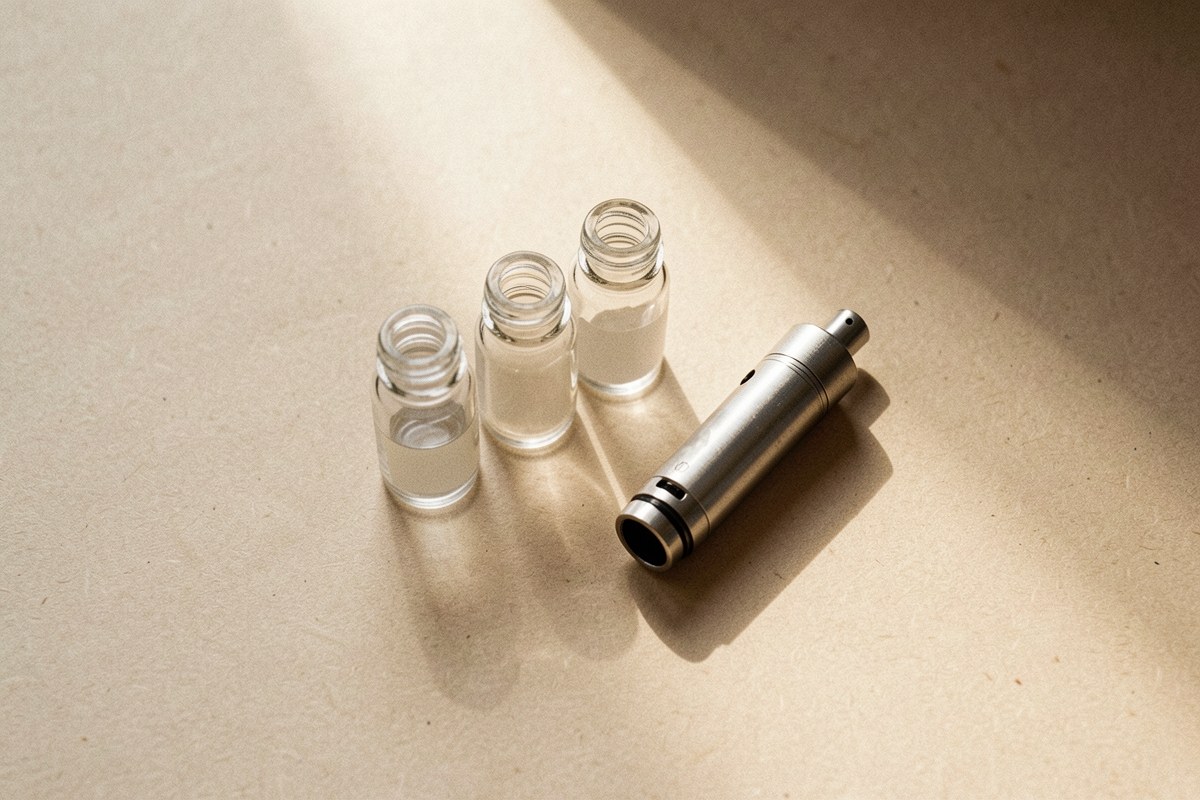
Choosing starter directions across scent families
The first decisions you make as a newcomer are about direction, not brand. A good beginner discovery set contains several different scent directions rather than repeated variations of one profile — for example fresh, clean, warm, floral, woody, musky or soft sweet fragrances. That spread is what teaches you where your taste actually sits.
This is why getting started with perfume is easier with a structured set than with one admired bottle. If every sample in front of you is a variation on the same fresh citrus theme, you will learn which citrus you prefer, but not whether you prefer citrus at all. Mixing families in a small group gives you contrast, and contrast is what makes a preference legible.
A practical way to build that group is to pick two directions from your mood answer and add one direction you would not normally choose. If you want to feel clean, take a fresh option and a soft musky option, then add a warm amber or woody scent as the outlier. You are not committing to any of them; you are testing whether your stated preference survives contact with your nose.
Keep the group small. Smelling many fragrances back to back flattens your perception and makes everything blur together. A handful of genuinely different directions will tell you more than a long list of near-duplicates.
- Aim for contrast: fresh, clean, warm, floral, woody, musky and soft sweet are all useful directions to include
- Avoid a starter set built entirely around one narrow profile
- Add at least one direction you would not normally pick, as a control
- Keep the first group small enough that you can still tell the scents apart afterwards
Sources: The Scent Blueprint, Zermat USA
Ordering or requesting your first small samples
Sampling is the step that separates a hobby from a series of expensive guesses. A discovery set reduces blind-buy risk because it lets you wear a fragrance during normal routines and compare it across more than one test before any money is committed to a full bottle. The stated purpose of sampling is not to accumulate samples; it is to learn which fragrances you actually wear.
Sample formats are usually small spray vials or travel-sized sprays. One fragrance house states that a 2ml spray sample provides roughly 25–30 sprays, which is enough to observe how a scent evolves over several wears. That is the brand's own guideline for its own sample size rather than a standardised industry volume, but it is a helpful mental anchor: a small spray vial is not a single test, it is a short relationship.
When you order, think about sequence as well as content. A lower-risk path described in beginner guidance is samples or a discovery set first, then travel sprays if the scent keeps working for you, and only then a full bottle. Each step costs more than the last, so each step should be earned by repeated wear rather than by a good first impression.
If you are requesting samples in a store or from a counter rather than ordering a set, ask for a small number of clearly different directions and note the names carefully so you can look them up later. The value of a sample is not just the liquid; it is the record you keep of it.
- Samples and discovery sets first
- Travel sprays second, if the scent keeps working across several wears
- A full bottle last, once a scent has a clear role in your routine
- Label every vial with its name and the date you first wore it
Sources: The Scent Blueprint, Goldfield & Banks (US)
Keeping simple notes on each sample
A fragrance journal is the cheapest upgrade to your nose. Beginner guidance recommends noting which scents you loved, liked or disliked, and when and where you tested them. That last part matters more than it sounds: the same fragrance worn on a hot afternoon and on a cold evening can read as two different scents.
Keep the format deliberately small so you will actually maintain it. A line per wear is enough. Note the fragrance name, the date, where you were, roughly what you thought in the first few minutes, and roughly what you thought after the scent had settled. You are not writing a review; you are recording evidence.
Over a few weeks, patterns appear that memory alone would miss. You may find that your favourite opening notes are not the base notes you actually enjoy wearing all day, or that a scent you dismissed in summer works well in cooler weather. That is exactly the information you need before spending on a bottle.
The technique around the notes matters too. A commonly recommended approach is to avoid testing more than three fragrances at once, to apply different scents to different areas such as each wrist and the inner elbow, and to wait at least 30 minutes before judging. If you follow that approach, your journal entries will be far more reliable. Judge on skin, not only on paper: paper strips do not show how a fragrance interacts with your skin.
- One line per wear: name, date, place, first impression, settled impression
- Test no more than three fragrances at a time
- Apply different scents to different skin areas so you can compare them
- Wait at least 30 minutes before deciding whether you like something
- Trust skin over paper strips
- Spray one fragrance on one wrist and another on the other wrist, keeping a third for the inner elbow at most
- Note the time and your first impression within the opening minutes
- Wait at least 30 minutes, then write down what the scent has become
- Re-wear the same fragrance on a different day before forming a firm view
Sources: Smytten Blogs, Be Frsh
Deciding when to buy your first full bottle
The moment to buy a full bottle is when a sample has become a habit, not when it has become a favourite. Those are different things. A favourite can be a single beautiful evening; a habit is something you reach for without thinking when you are getting dressed.
A more useful question than do I like this is what role would this fragrance play. Assigning each fragrance a role — everyday, evening, or already too similar to something you own — is the practical buying question. If a scent is beautiful but duplicates a role you have already filled, a full bottle is unlikely to earn its place. If a scent fills a gap you keep noticing, that is a strong signal.
The staged path described in beginner sampling guidance supports the same conclusion: use samples or a discovery set first, move to a travel spray if the scent keeps working, and only then commit to a full bottle. The travel-spray step exists precisely to test whether a fragrance survives real life — commuting, weather, work, repeated wear — before you buy a large volume of it.
There is no reliable rule for how many samples should come before a bottle, and any specific number would be arbitrary. The honest test is behavioural: you have worn it more than once, you have worn it in more than one setting, and you still reach for it.
- Buy when the sample has become a habit, not when it has produced one good evening
- Ask what role the fragrance fills, not only whether you like it
- Check whether it duplicates something you already own
- Let a travel spray absorb the risk before a full bottle does
Sources: The Scent Blueprint
Avoiding blind buying and trend-chasing
Blind buying — purchasing a full bottle you have never worn — is the single most common way beginners spend money on fragrances they do not use. Sampling exists specifically to reduce that risk, because wearing a scent through an ordinary day reveals things a description or a review cannot.
Beginner guidance lists several recurring mistakes worth watching for. They include testing every sample in one sitting, judging a scent only from its opening notes, buying a full bottle before wearing the sample more than once, choosing a set because of brand hype, and keeping several fragrances that serve the same role. Each of these is a shortcut around the sampling process, and each one tends to end in an unused bottle.
Trend-chasing is the same shortcut wearing different clothes. A fragrance being widely discussed does not tell you how it will behave on your skin, in your climate, or in your daily routine. It is perfectly reasonable to start with a well-known designer fragrance — but start with a sample of it. The brand's fame is not evidence that the scent suits you.
There is one practical caution worth including alongside the sampling routine. A 24-hour patch test on the inner forearm before regular wear is recommended so that skin reactions are detected on a small area rather than after liberal application. If you have known sensitivities or a skin condition, that is a conversation for a qualified professional, not a fragrance blog.
- Do not test everything in one sitting
- Do not judge on opening notes alone
- Do not buy a bottle before wearing the sample more than once
- Do not choose a set because of brand hype
- Do not accumulate fragrances that all serve the same role
- Consider a small inner-forearm patch test before regular wear, especially if you have known sensitivities
Sources: The Scent Blueprint, Smytten Blogs, Be Frsh
Your first six months, step by step
Everything above becomes manageable when it is spread over a few months rather than compressed into a weekend. The sequence below is a light structure, not a schedule you have to keep. Its purpose is to make sure sampling happens before spending, and reflection happens before both.
The first weeks are for vocabulary and contrast. The middle months are for repeated wear and honest notes. The later months are for the buying decision, made on evidence you collected yourself. If at any point a fragrance clearly is not for you, drop it and move on — that is a result, not a failure.
- Weeks 1–2: learn the three-stage note structure and the rough meaning of concentration labels
- Weeks 2–4: get a small set of samples spanning several clearly different scent directions
- Weeks 4–12: wear samples one or two at a time, on skin, and keep a short journal entry for each wear
- Weeks 12–20: re-wear anything promising, in at least two different settings or seasons
- Weeks 20–26: if a scent keeps working and fills a role you do not already have, buy the smallest full or travel size first
- Ongoing: revisit your notes every few months; taste shifts, and older entries explain decisions you would otherwise repeat
Sources: The Scent Blueprint, Smytten Blogs, Goldfield & Banks (US)
Frequently asked questions
How much should a beginner spend in the first year?
There is no responsible figure to quote here, and any specific budget total would be guesswork. What the guidance does support is a spending order: samples or a discovery set first, then a travel spray if the scent keeps working, and only then a full bottle. Each step costs more than the previous one and should be earned by repeated wear, so the total you spend in a year largely depends on how many scents pass that test. Keeping to the staged order is the practical way to avoid spending on bottles you will not use.
Sources: The Scent BlueprintShould I start with a discovery set or individual samples?
A discovery set is usually the more efficient start, because its value comes from contrast: a beginner set works best when it contains several different scent directions rather than repeated variations of one profile. Individual samples are useful once you already know which directions you want to explore more deeply, or when you want to test a specific fragrance you have read about. Either way, the point of sampling is not to accumulate vials — it is to learn which fragrances you actually wear.
Sources: The Scent BlueprintHow many samples before buying a bottle?
There is no reliable number, and stating one would be inventing a rule. The guidance is qualitative rather than numerical: wear the sample more than once before buying a full bottle, and move through a travel spray before committing to a full size if the scent keeps working for you. In practice, the test is behavioural — you have worn it on more than one occasion, in more than one setting, and you still reach for it. If that is not yet true, keep sampling.
Sources: The Scent BlueprintDo I need to learn every scent family first?
No. A simpler starting framework works better: decide how you want to feel — fresh, romantic, warm, bold or clean — then explore one or two fragrance families that match that mood in a small group of scents instead of smelling everything at once. You will still need a rough grasp of the three-stage note structure and of what concentration labels mean, because those explain why a scent changes over the day. But a complete map of every family is not a prerequisite for starting.
Sources: Zermat USAIs it fine to start with a well-known designer fragrance?
Yes, as long as you start with a sample rather than a blind bottle. A widely discussed fragrance is a reasonable place to begin because it is easy to find and easy to sample, but its reputation tells you nothing about how it will behave on your skin, in your climate or in your daily routine. The guidance against blind buying applies just as much to famous scents as to obscure ones: wear it more than once before committing, and judge it on skin rather than on paper.
Sources: Smytten Blogs, Zermat USAHow do I test a sample properly?
A commonly recommended approach is to avoid testing more than three fragrances at once, apply different scents to different areas such as each wrist and the inner elbow, and wait at least 30 minutes before judging. Paper strips alone are not enough, because they do not show how a fragrance interacts with your skin. If you have known sensitivities, a 24-hour patch test on the inner forearm before regular wear is a sensible precaution; skin conditions and possible allergies are matters for a qualified professional.
Sources: Smytten Blogs, Be FrshWhy does a perfume smell different after an hour?
Because fragrance is built in stages. Top notes are the initial impression and are the most volatile, typically lasting roughly the first 15 minutes. Heart or middle notes follow and carry the main personality of the scent. Base or dry-down notes are the least volatile and can linger on skin for hours. Judging a fragrance only from its opening notes is a common beginner mistake, which is why a 30-minute wait before forming a view is worth building into your routine.
Sources: Smytten Blogs, Zermat USAWhat is the most common beginner mistake?
The recurring mistakes are all shortcuts around sampling: testing every sample in one sitting, judging a scent only from its opening notes, buying a full bottle before wearing the sample more than once, choosing a set because of brand hype, and keeping several fragrances that serve the same role. Blind buying is the pattern underneath most of them. Wearing a sample more than once, in more than one setting, removes most of that risk at very little cost.
Sources: The Scent BlueprintSources
- Discovery Sets Guide | The Scent Blueprint — The Scent Blueprint
- How to Discover Fragrance: A Perfume Beginner's Guide — Smytten Blogs
- Perfume 101: A Beginner's Complete Guide — Zermat USA
- Perfume Discovery Process: A Sampling Guide — Be Frsh
- The Art of Perfume Discovery: How Sample Sets Unveil Your Olfactory Journey – Goldfield & Banks — Goldfield & Banks (US)